How Strait of Hormuz Tensions, Panic Buying, and Induction Cooking Are Reshaping the Indian Kitchen
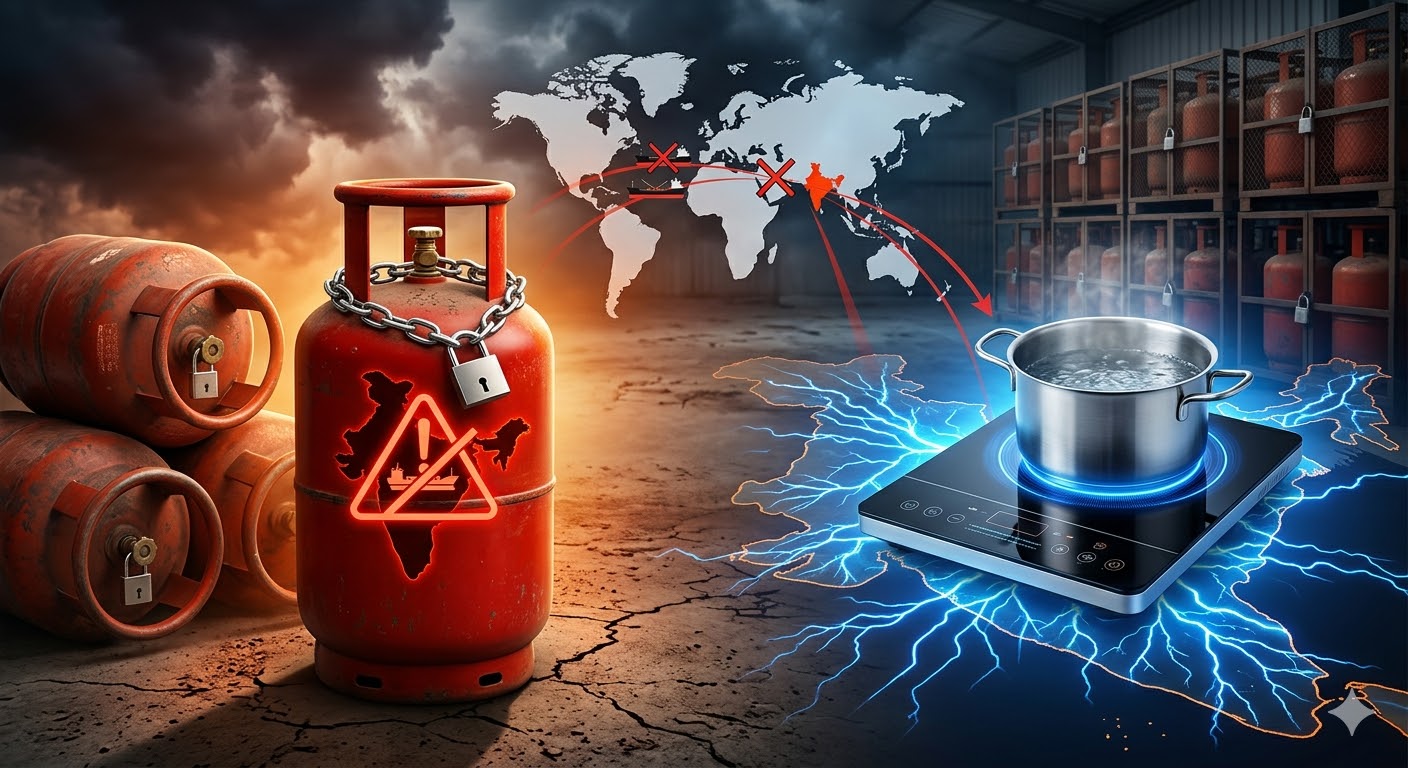
A geopolitical shock in the Middle East pushed a fragile supply chain to the brink, ignited a wave of panic buying, and accelerated an ongoing consumer shift toward electric cooking. The crisis began at the Strait of Hormuz, whose disruption reduced LPG cargo arrivals by ~30%. India’s import dependence and last-mile logistics magnified that shock into a 36–40% surge in cylinder bookings. Government interventions and diversification measures have contained systemic risk—but the episode has already altered consumer behavior and the strategic trajectory of India’s kitchen energy market.
The trigger: chokepoint and cargo shortfall
Most of India’s imported LPG flows from Gulf suppliers. Key suppliers—Qatar, United Arab Emirates and Saudi Arabia—route product through the Strait of Hormuz. Military activity and warnings forced vessels to delay or reroute, lifting insurance and transit costs and cutting weekly LPG arrivals to India by roughly 30%. The supply shock exposed a simple fact: a geographically concentrated import route creates disproportionate downstream volatility.
The behavioral multiplier: panic booking by the numbers
Before the crisis, oil marketing companies processed ~5.57 million domestic cylinder bookings daily. That figure has jumped to ~7.57 million—an incremental 2 million bookings per day, or a 36–40% surge. This is not consumption growth; it is hoarding. The booking spike strained distribution nodes (bottling, truck cycles, last-mile delivery), creating localized shortages and feeding a feedback loop: perceived scarcity → real distribution stress → more panic.
Supply buffers and policy response
India is not defenseless. The country—India—maintains layered buffers and executed rapid policy moves:
- Inventory buffers: Underground caverns (Visakhapatnam and Mangaluru) plus above-ground stocks yield roughly 25–30 days of cooking-gas cover. Visakhapatnam and Mangaluru were referenced as strategic storage points.
- Crude coverage: Strategic Petroleum Reserves and commercial stocks provide about 74 days of crude, enabling refineries to keep producing LPG.
- Production ramp: Refineries were pushed above 100% capacity, lifting domestic LPG output by about 30%.
- Regulatory steps: The government invoked emergency powers to prioritize household supply, mandated a 25-day wait between bookings, and barred dual-users (PNG customers) from hoarding.
- Diversification: Contracts for ~2.2 million metric tons of LPG from the United States were secured to bypass the Hormuz route.
These moves reduced systemic risk and signaled that shortages would likely be short-term if panic subsides.
Market economics: price signal and consumer substitution
Retail prices in metros rose toward ₹900–₹1,050 per 14.2 kg cylinder, materially raising monthly household energy bills. That price shock, plus visible supply risk, accelerated an existing tendency: urban households experimenting with induction cooking.
Key comparative metrics:
- Monthly running cost (typical urban household): LPG ≈ ₹900+; Induction electricity ≈ ₹640 → saving ≈ ₹200–₹300/month.
- Efficiency: LPG stoves convert ~40–55% of fuel into useful heat; induction operates at ~85–90%.
- Setup differences: Induction requires compatible cookware and an initial appliance purchase; LPG requires cylinders and recurring logistics.
The arithmetic and convenience of induction, combined with the pain of frequent price cycles, made induction stoves fly off shelves during the panic.
Structural limits and the hybrid outcome
Despite its momentum, induction cannot instantly replace LPG given India’s cooking practices—high-heat tadka, phulkas/rotis, heavy-wok cooking and deep frying rely on open flame or specific cookware. The realistic market outcome is hybrid kitchens: households retain LPG for traditional tasks and adopt induction for quick, safe, and efficient cooking.
Projected direction over the next decade (directional, not precise): LPG share will decline from current majority levels toward a smaller but still significant share, while electric cooking (induction + smart electric appliances) will move from single-digit penetration into a substantial urban segment.
Strategic implications (consulting takeaways)
- Companies: Appliance makers (induction and multi-cookers), cookware firms, and consumer-finance players should accelerate product bundles and EMI offers targeting urban households converting under price stress.
- Retailers/OMCs: Oil marketing companies must harden last-mile logistics, introduce anti-hoarding controls, and invest in digital rationing mechanisms to dampen panic cycles.
- Policy: Maintain diversified import lanes, expand strategic storage, and communicate transparent stock dashboards to reduce behavioral shocks.
- Investors: Look for asymmetric opportunities in electric cooking ecosystems (appliances, IoT cooking, and energy-efficient cookware) and logistics technologies that resolve cylinder distribution frictions.