
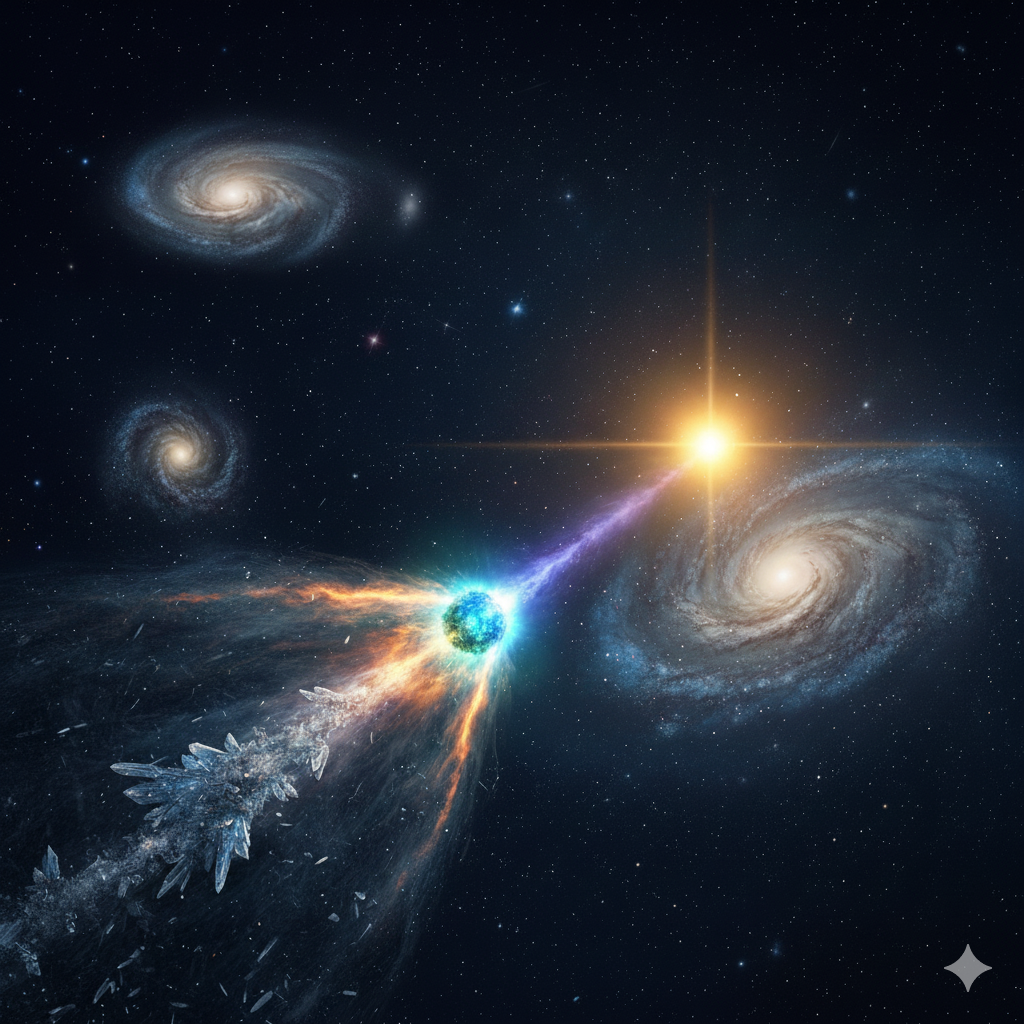
Synopsis
The scientific community has been left stunned by revelations that 3I/ATLAS, the third interstellar object ever detected in our solar system, may be between eight and 14 billion years old. This would make the comet a relic of the early universe, predating the birth of our Sun. With a unique chemical signature and unusual “wobbling” jets, 3I/ATLAS is being hailed as the most significant astronomical event of the decade, sparking intense debate over whether it is a piece of ancient cosmic history or a scout from another civilization.
A Visitor from the Dawn of Time
Following its closest approach to Earth on December 19, 2025, the interstellar comet 3I/ATLAS is now drifting away, leaving researchers with data that challenges our understanding of the cosmos. As only the third confirmed interstellar visitor—following 1I/ʻOumuamua and 2I/Borisov—3I/ATLAS stands out due to its staggering estimated age.
Michele Bannister, an associate professor at the University of Canterbury, is leading an investigation into the object’s origins. According to her team’s research, the comet could be up to 14 billion years old. “The UC team, in partnership with Professor Chris Lintott at the University of Oxford, was the first to provide the theoretical study that showed how old the comet was based on its velocity,” Bannister told Astrobiology.
If these estimates are accurate, 3I/ATLAS was already ancient by the time our Sun began to coalesce from a cloud of dust five billion years ago.
Alien Chemistry and the “Anti-Tail” Mystery
The comet’s composition has sent shockwaves through the scientific world, as it appears fundamentally different from anything native to our solar system. As it traversed our skies, researchers detected:
- Rich Metallic Emissions: Unusual levels of atomic nickel and iron, marking it as a clear “outsider.”
- Carbon Dioxide Surplus: Data from the James Webb Space Telescope (JWST) confirmed it is exceptionally rich in 10% $CO_{2}$, suggesting it formed in a frigid environment far from any typical star.
“The chemistry of 3I/ATLAS is distinctive,” Bannister explained. “It tells us that its home environment was unlike our own.”
The Enigma of the Wobbling Jets
Perhaps most baffling are the physical maneuvers of the comet. Between July and September 2025, astronomers at the Teide Observatory in Tenerife observed the comet’s coma evolve from a simple fan-shaped cloud into a complex structure featuring a sun-facing “anti-tail.”
Within this structure, scientists identified wobbling jets that shifted every 7 hours and 45 minutes. This pattern suggests a total rotation period of 15.5 hours, characterized by a systematic “precession”—a wobbling motion that some researchers find so precise it has fueled controversial theories about the object being artificial.
Conclusion
Whether 3I/ATLAS is a pristine messenger from the early universe or a craft from a distant civilization, it has provided a rare glimpse into the deep history of space. As it heads back into the interstellar void, it leaves behind a mystery that may take generations to solve.