
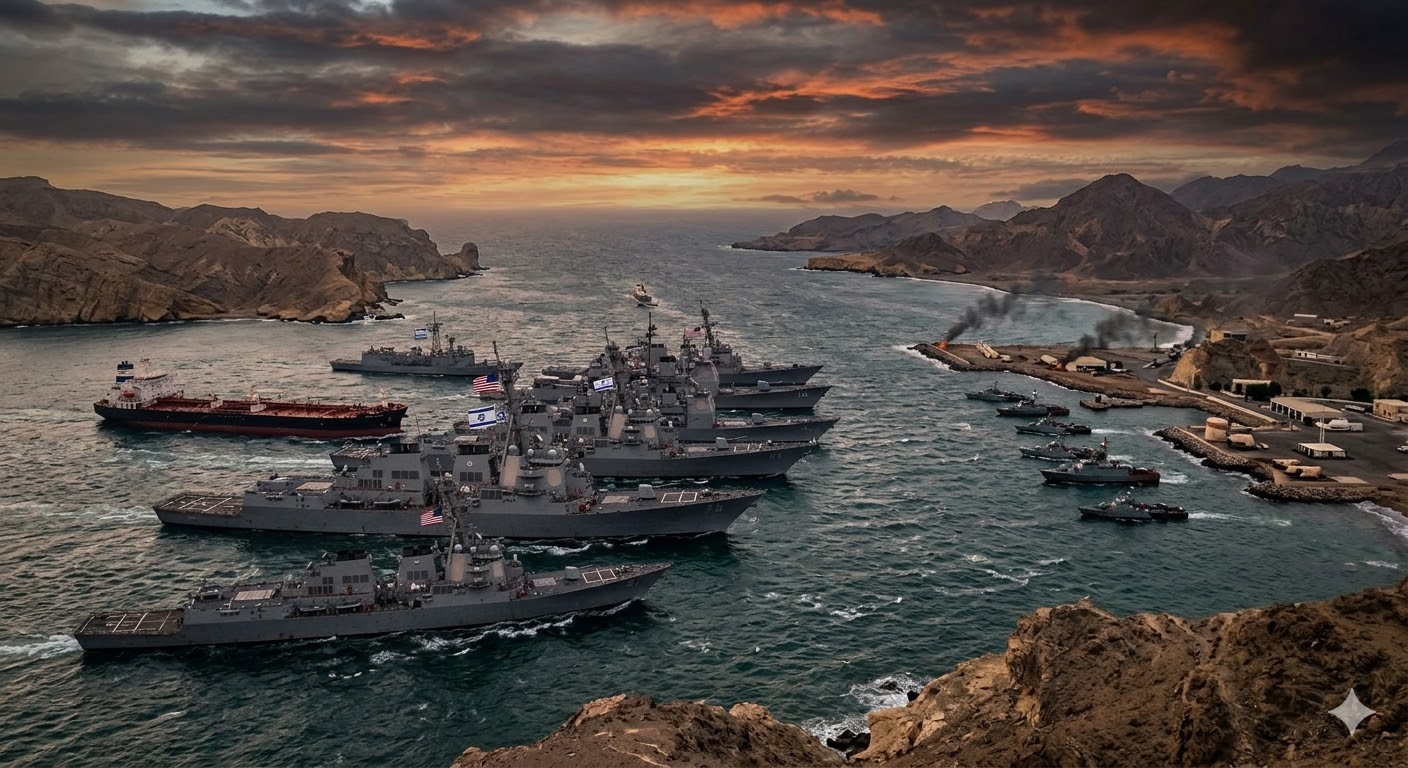
A Geopolitical Flashpoint Turns Into a Global Economic Crisis
The ongoing US–Israel military conflict with Iran has rapidly evolved beyond a regional confrontation into a full-scale geopolitical and economic disruption. Now in its third week, the Strait of Hormuz crisis has reached a critical tipping point with Iran’s effective closure of the Strait of Hormuz—one of the most strategically important oil transit chokepoints in the world.
This narrow maritime corridor is responsible for nearly 20% of global oil supply and close to 30% of seaborne crude trade, making it central to global energy security. With tanker movement stalled and naval tensions rising, the impact is no longer confined to the Middle East—it is reverberating across global oil markets, supply chains, and inflation trajectories.
What makes this crisis different, however, is not just the scale of disruption—but the unexpected breakdown of coordination among Western allies.
Why the Strait of Hormuz crisis Matters for Global Oil Supply and Energy Markets
To understand the magnitude of the current crisis, you need to look at the numbers—not the headlines.
- 20–21 million barrels per day (mb/d) of oil pass through the Strait of Hormuz
- Nearly 25% of global LNG exports, particularly from Qatar, depend on this route
- Major economies like India, China, Japan, and South Korea rely heavily on this corridor for energy imports
Any disruption here creates an immediate global oil supply shock, triggering volatility in crude oil prices, shipping costs, and insurance premiums.
Early signals are already visible:
- Brent crude projections moving toward $100–120 per barrel
- Rising tanker insurance costs due to war-risk premiums
- Increased pressure on global supply chains and logistics networks
This is classic supply-side inflation. And unlike demand-driven inflation, it’s harder to control.
“Not Our War”: Why US Allies Refused Military Support
In response to Iran’s blockade, US President Donald Trump called on NATO allies and Indo-Pacific partners to deploy naval forces to secure shipping routes in the Persian Gulf. What followed was a rare and unified rejection.
- Germany openly declined involvement, signaling non-alignment
- The United Kingdom emphasized diplomacy over military escalation
- France and the European Union refused to expand naval missions
- Japan, South Korea, and Australia avoided direct military participation
This is not a minor disagreement—it is a clear signal of strategic divergence within Western alliances.
The core issue is simple: the US initiated military escalation without building prior consensus, and then expected allies to share the burden. That model is no longer viable in today’s geopolitical environment.
The Real Reason Behind Allied Resistance: Strategic and Economic Calculations
Calling this “lack of support” misses the point. This is calculated decision-making.
1. High Risk, Low Strategic Return
European and Asian economies face severe economic exposure to oil price shocks, but gain little from direct military involvement.
2. Fear of Regional War Escalation
Iran’s asymmetric capabilities—missiles, drones, proxy networks—create the risk of a wider Middle East conflict affecting multiple trade routes.
3. Domestic Economic Pressures
With inflation already a concern, entering a war that could spike oil prices further is politically unsustainable.
4. Shift Toward Strategic Autonomy
The European Union is increasingly pursuing independent foreign policy decisions rather than automatic alignment with US military actions.
This isn’t alliance collapse—it’s alliance recalibration based on national interest.
Trump’s Strategic Contradiction and Its Impact on NATO Relations
President Trump’s response has only deepened the complexity of the situation.
On one hand, he criticized allies for not supporting the US, highlighting decades of American military spending. On the other, he dismissed their importance, stating that the US does not need allied assistance.
This contradiction creates a credibility problem.
You cannot undermine alliances rhetorically and expect operational cooperation during crises. The result is predictable: allies begin to hedge, diversify partnerships, and reduce dependency on US-led security frameworks.
This crisis may not break NATO—but it weakens its cohesion at a critical moment.
Global Economic Impact: Oil Prices, Inflation, and Supply Chain Disruptions
The closure of the Strait of Hormuz is already translating into economic pressure worldwide.
Rising Oil Prices and Inflation Risk
A sustained increase of even $10–15 per barrel in crude oil prices can:
- Add 0.3–0.5% to global inflation
- Delay interest rate cuts by central banks
- Increase fuel and transportation costs globally
Supply Chain Disruptions
Higher oil prices directly impact:
- Shipping and freight costs
- Manufacturing inputs
- Aviation and logistics sectors
This creates a ripple effect across industries, from consumer goods to heavy manufacturing.
Impact on India and Emerging Markets
India, which imports nearly 85% of its crude oil, is particularly vulnerable:
- Increased import bills
- Pressure on the rupee
- Widening current account deficit
For emerging markets, this is not just an energy crisis—it’s a macroeconomic risk.
Second-Order Effects: What This Crisis Means for the Future of Global Trade
Most surface-level analyses stop at oil prices. That’s shallow thinking.
Acceleration of Energy Diversification
Countries will push harder toward:
- Renewable energy investments
- Strategic petroleum reserves
- Alternative oil supply routes
Fragmentation of Maritime Security
Instead of coordinated global responses, expect:
- Regional naval coalitions
- Increased private maritime security
- Higher shipping insurance costs
Long-Term Shift in Global Trade Systems
Disruptions in critical trade routes can accelerate:
- Bilateral trade agreements outside traditional systems
- Reduced dependence on single chokepoints
- Gradual experimentation with non-dollar trade settlements
These shifts won’t happen overnight—but the direction is clear.
Strategic Outlook: A Fractured Global Order in the Making
This crisis is not an isolated geopolitical event. It is a signal of a deeper structural shift in global power dynamics.
- US unilateral actions are increasing
- Allied alignment is weakening
- Global coordination mechanisms are becoming less reliable
The world is moving from a unipolar, alliance-driven system to a more fragmented and transactional geopolitical order.