A New Automotive Player Enters the Arena
India’s passenger vehicle market is about to gain a powerful new entrant. JSW Group, widely known for its leadership in steel, energy, infrastructure and cement, is officially stepping into the automotive sector through its new division, JSW Motors. This move marks one of the most significant industrial expansions by an Indian conglomerate into the passenger vehicle space in recent years.
To accelerate its entry, JSW Motors has partnered with China’s Chery Automobile, the parent company of the Jetour brand. The collaboration will bring globally developed platforms to India with heavy localisation and domestic manufacturing. The first product from this partnership will be a rugged, technology-focused SUV derived from the Jetour T2.
The vehicle is expected to launch around Diwali 2026, positioning it perfectly for the festive buying season. Production will take place at JSW’s upcoming facility in Chhatrapati Sambhajinagar, Maharashtra. With plug-in hybrid technology, advanced driver assistance systems and a bold design philosophy, this SUV is intended to make a strong first impression in the competitive Indian SUV landscape.
A Rugged Lifestyle SUV with Strong Road Presence
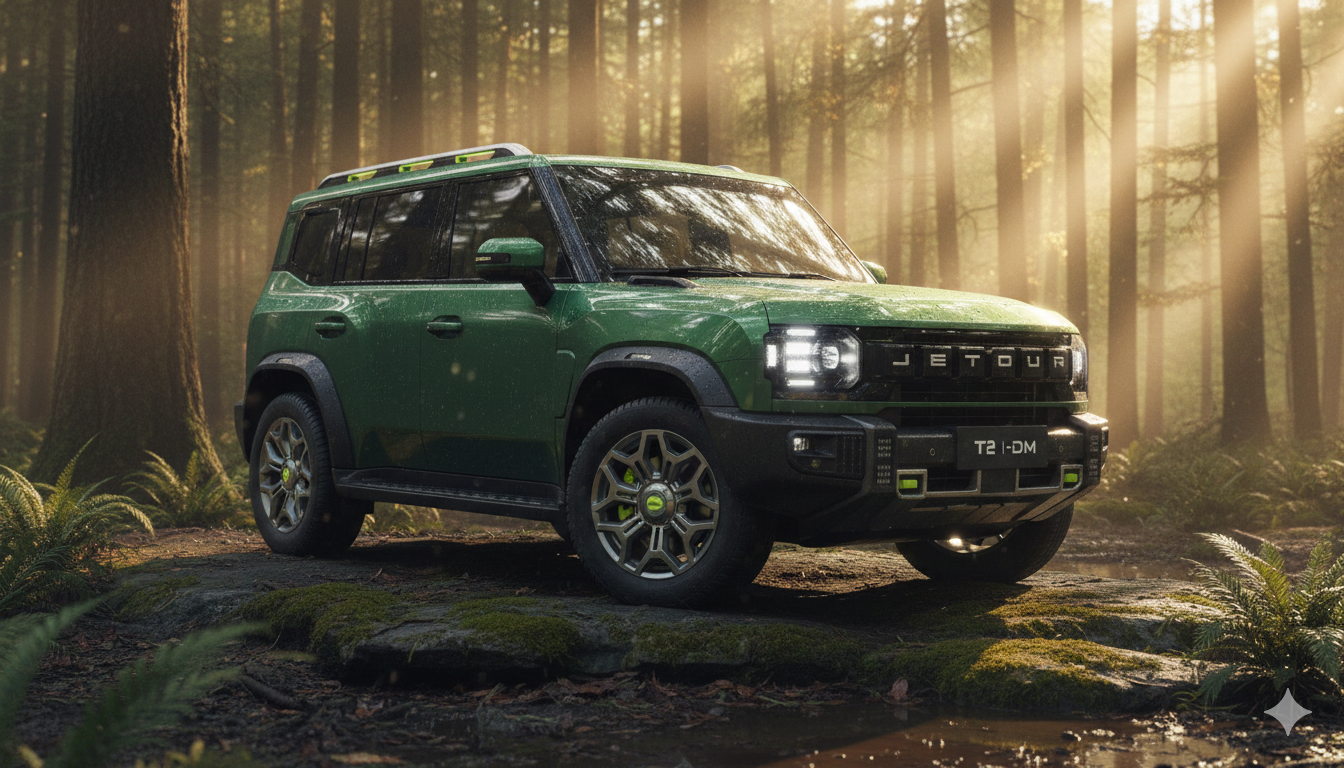
The upcoming JSW SUV adopts the Jetour T2’s distinctive boxy styling, which has already gained global attention. Unlike the curved crossover designs common in today’s market, this vehicle embraces a rugged and upright stance inspired by iconic off-road SUVs.
Globally, the Jetour T2 measures approximately 4,785 mm in length, 2,006 mm in width and 1,880 mm in height, with a 2,800 mm wheelbase. These proportions give it a commanding road presence and position it firmly in the D-segment SUV category.
The front design is defined by a large rectangular grille, squared LED headlamps and a chunky bumper with skid-plate styling. From the side, the flat body panels, prominent wheel arches and strong cladding emphasise durability and off-road capability. A floating roof design adds a modern visual touch.
At the rear, vertically stacked LED tail lamps and a tailgate-mounted spare wheel reinforce the vehicle’s adventure-ready character. The India-spec version will replace Jetour branding with JSW badging while retaining the overall design language.
Powertrain & Performance: Plug-In Hybrid Technology for India
JSW Motors is expected to introduce the SUV with a plug-in hybrid powertrain, making it one of the few vehicles in its segment to adopt this technology at launch.
The system is likely to use Chery’s i-DM hybrid architecture, combining a 1.5-litre turbocharged petrol engine with dual electric motors. The petrol engine produces around 154 hp, while the combined system output is expected to reach approximately 221 hp and 390 Nm of torque.
A 26.7 kWh battery pack will power the electric motors, offering an estimated electric-only driving range of up to 139 km under ideal testing conditions. This allows daily commuting to be completed using electric power alone, significantly reducing fuel consumption.
The hybrid setup aims to provide the efficiency of electric driving in cities while retaining the long-distance flexibility of a petrol engine. This approach is particularly relevant for India, where charging infrastructure is still developing.
Interior, Technology & Safety: Feature-Rich Cabin Experience
Inside, the SUV is designed to deliver a premium and technology-driven cabin experience.
The dashboard is dominated by a 15.6-inch touchscreen infotainment system paired with a 10.25-inch digital instrument cluster. This dual-screen setup forms the technological core of the interior.
Expected features include a Sony premium audio system, panoramic sunroof, dual-zone climate control, ambient lighting and powered front seats. High-quality materials and soft-touch surfaces aim to enhance the overall premium feel.
Safety will be a key focus, with Level-2 Advanced Driver Assistance Systems expected to be offered. Features may include adaptive cruise control, lane-keeping assist, autonomous emergency braking and blind-spot monitoring. The SUV is also expected to offer six airbags and a 540-degree camera system for enhanced visibility.
Manufacturing & Localisation: Building in India for India
Production of the SUV will take place at JSW’s new manufacturing plant in Chhatrapati Sambhajinagar. Initial units will be assembled from imported kits, but localisation will increase rapidly.
JSW aims to achieve up to 80% localisation within the first year of production. This includes sourcing body components, interiors, glass and electric motors locally. High localisation levels are expected to improve cost competitiveness and strengthen supply chains.
The manufacturing strategy reflects JSW’s long-term commitment to building a domestic automotive ecosystem.
Market Positioning & Expected Pricing
Pricing estimates currently range widely depending on variants and features. Entry-level versions could begin in the ₹15–30 lakh range, while fully loaded plug-in hybrid models may approach ₹40–45 lakh.
The SUV will compete with multiple segments simultaneously, targeting buyers considering the Mahindra XUV700, Tata Safari, Jeep Meridian and Mahindra Thar.
JSW is attempting to position the vehicle as a hybrid lifestyle SUV offering premium technology and rugged styling in a single package.
Expanding the Portfolio
The Jetour T2-based SUV will be the first of several planned products. JSW has already hinted at a second vehicle launch in 2027, potentially an electric model.
This automotive venture operates independently from JSW’s partnership with MG Motor India, highlighting the group’s broader ambitions in the mobility space.
JSW Motors’ first SUV represents a major step into the passenger vehicle industry. By combining global technology, local manufacturing and hybrid powertrains, the company aims to establish a strong foothold in India’s growing SUV market.
The Diwali 2026 launch could mark the beginning of a new competitive era in the Indian automotive industry.